AI-powered sustainability data: Can you bank on it?

We’re coming to the collective realisation that not all AI can be trusted. In fact, you can only trust it as far as you trust the data behind it, and the motives of those managing it. AI-powered sustainability data has become popular for good reason: AI has gotten remarkably good at pulling a number out […]
Nature Data for Investors: Proud to Support Northern Trust Asset Management
We’re proud to share that GIST Impact contributed as a data provider to Nature in Portfolios: A Practical Framework for Investment Decision-Making, a new report from Northern Trust Asset Management (NTAM). The report shows how nature data can and should be used in investment decisions today, and makes the case for nature and climate being […]
GIST Impact wins Best Sustainable Technology and Support Services Provider 2026
We are delighted to announce that GIST Impact has won Best Sustainable Technology and Support Services Provider at the 2026 Investment Week Sustainable Investment Awards. It is the second consecutive year we have received this recognition, following our win in 2025. A second year of recognition Winning once is a privilege. Winning again is a […]
Nature Meets Climate: Their Combined Financial Risk
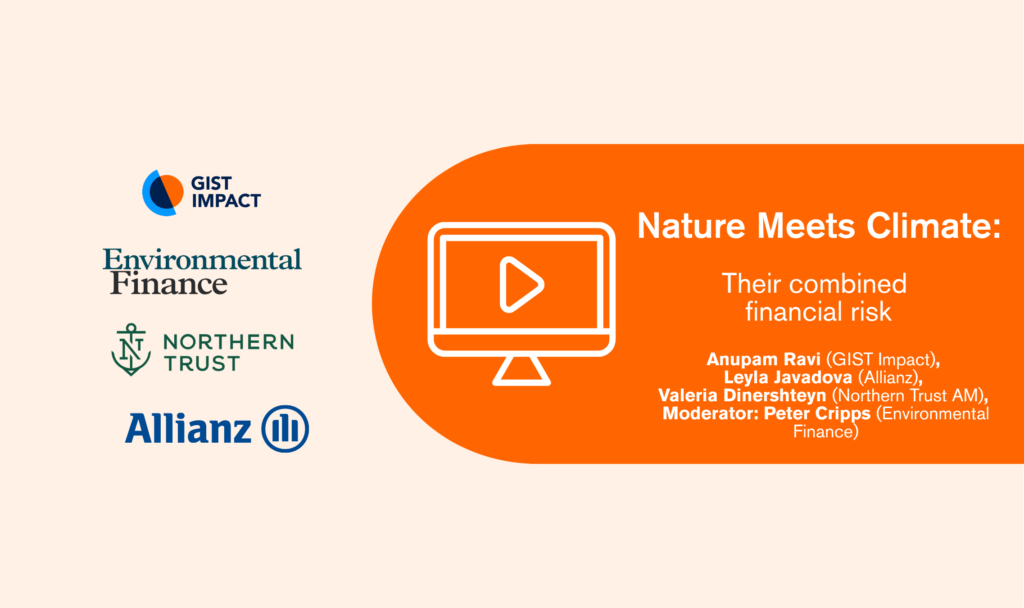
Nature risk and climate risk are usually assessed as separate problems. In practice, they rarely behave that way – the real exposure for investors and asset managers often sits where the two overlap. That was the starting point for our recent webinar, hosted by Environmental Finance, bringing together experts from GIST Impact, Allianz and Northern […]
Key Takeaways: ‘The Accounting Paradox’ Book Launch

On 26 August 2026, social impact champions, regulators, corporate leaders and public health experts gathered together in New Delhi, and sat around one table to ask a deceptively simple question. What if the way we measure profit has been hiding the real cost of doing business all along? The event marked the launch of a […]
A Pocket Guide to: Nature Data Metrics

Heavy jargon makes nature data tough to navigate. This pocket guide is a reference companion with easy to digest breakdowns of the most common nature data metrics that financial institutions (FIs) use. We unpack what each metric measures alongside practical examples of usage showing how to evaluate nature dependencies and impacts, as well as risks […]
We don’t compete with open source data, we complete it

For most organisations that are starting their sustainability journeys, open-source sustainability data presents itself as a natural first step. This is rightfully so; over the past few years, open-source data has moved mountains to democratise both nature and climate intelligence by providing scientifically backed datasets equipped with the correct information that companies require. However, there […]
Introducing our Indigenous Peoples and Local Communities dataset

Yanomami. Batwa and Bambuti. Saami. Jenu Kuruba. Chances are, none of these names are familiar. Yet each is an indigenous community currently in the news for the same reason: loss of habitat to development activity. This is not incidental. Standard ESG datasets rarely capture indigenous communities. That’s not because they lack materiality, but because no […]
Jonquil Hackenberg joins our Advisory Board

GIST Impact is delighted to announce the appointment of Jonquil Hackenberg to our Advisory Board. Jonquil brings 25 years of executive leadership in large-scale transformation, climate, resource recovery, water systems and decarbonisation. Her most recent position has been as Chief Executive of the Ellen MacArthur Foundation, the world’s leading circular economy NGO, refocusing a global […]
GIST Impact’s 2025 TNFD Report
Over half of global GDP is estimated to be moderately or highly dependent on nature. As ecosystems degrade, that dependency turns into real business risk. These show up as disrupted supply chains, water and energy insecurity, stranded assets, tightening regulation. The Taskforce on Nature-related Financial Disclosures (TNFD) exists to help organisations get ahead of that […]