


LONDON, 25 February 2026 – GIST Impact today announced the launch of its new Nature Value at Risk (NVaR) dataset, designed to help financial institutions quantify how the degradation of natural capital translates into financial risk at the portfolio and company level.
The launch marks a significant milestone in making nature-related financial risk actionable for investors. The dataset is the first to translate nature-related risk assessment methodologies featured in European Central Bank (ECB) and London School of Economics research into a practical tool for global portfolio analysis.
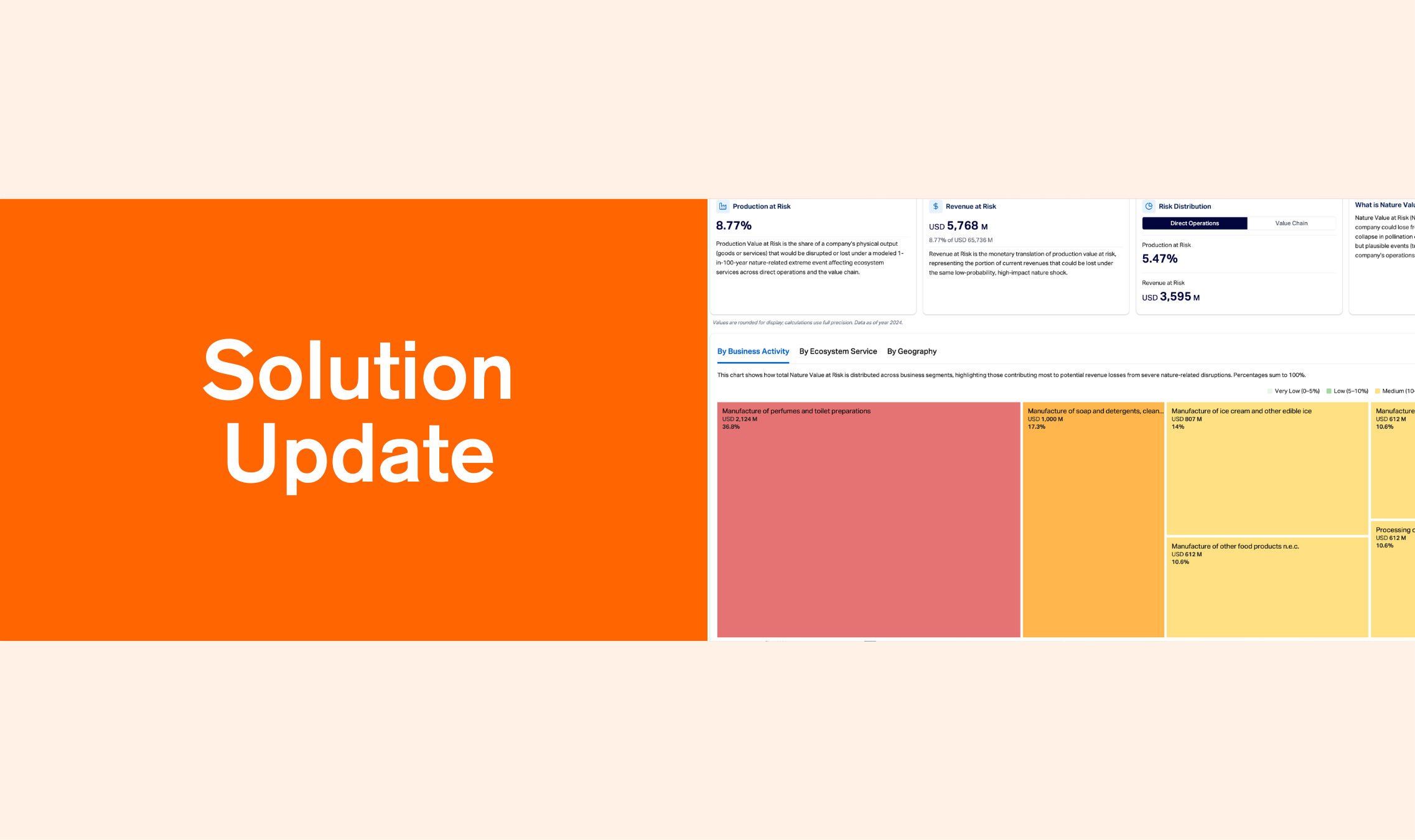
Nature Value at Risk measures how much of a company’s production and related financials could be lost if the natural systems it depends on – such as clean water, pollinating insects, or flood-buffering wetlands – were severely degraded at its own operations and across its supply chain.
“We’ve long been able to demonstrate that nature delivers considerable economic value to our economies. The question the financial sector has been wrestling with of late is what financial risk the degradation of nature exposes their portfolios to. Nature Value at Risk answers that question, translating the risk of ecosystem losses into financial metrics that investors understand and can defend to their boards,” said Pavan Sukhdev, CEO, GIST Impact. “We hope that this dataset will help the market to explore, collaborate, and evolve one standard, global, evaluation framework for NVaR. This is an overriding goal for our collaborators and ourselves and will be our immediate priority.”
GIST Impact’s methodology is a geo-sector-based calculation, reflecting that risks depend on the business activities a company is involved in and the specific geographic locations where it operates. The dataset covers direct operations as well as risks embedded in the upstream value chain. It takes into account the health of ecosystems in specific locations, as well as the resilience and adaptation capabilities of companies in those locations.
A preview of the NVaR dataset’s capibilities, for an anonymised company.
“We developed this Nature Value at Risk dataset in direct response to what we were hearing from clients: a need for nature risk analysis that aligns with the latest research from the ECB and leading academics, while also being readily deployable across portfolios,” said Dr. Thomas Moran, VP and Head of Nature and Biodiversity Products at GIST Impact. “The transparency we’ve embedded in the tool also means investors can see directly which business activities, ecosystem services and geographic factors are driving their risk.”
This initial release focuses on physical risks that affect twenty-five distinct ecosystem services, including water supply, climate regulation, pollination, and flood control. It is intended to support portfolio-level exposure analysis as well as company deep dives, stewardship activities, and TNFD-aligned reporting.
In the second quarter of 2026, GIST Impact will expand the dataset to incorporate transition risks arising from regulatory shifts and market preferences, drawing on their expertise on natural capital valuation. The company is also engaging with researchers, financial institutions and industry groups to advance methodological transparency and consistency across the emerging field of nature-related financial risk analysis.
GIST Impact’s Nature Value at Risk dataset is now available, covering over 18,000 companies through data feed, APIs and GIST Impact’s data platform.
To learn more, please contact info@gistimpact.com, or get in touch with a member of our team here.
–ENDS–
GIST Impact Media Contact
Alexandra Downs, alexandra@gistimpact.com
About GIST Impact
GIST Impact is a leading provider of environmental and social data and intelligence. Drawing on two decades of specialist experience, GIST Impact delivers decision-grade, location-specific data that helps investors and corporates understand how climate, nature and social factors affect risk, performance and long-term value.
Our analytics are used globally to inform investment decisions, risk management, stewardship and reporting, supporting alignment with leading frameworks and regulations including TNFD, CSRD, ISSB and Social Value requirements.