

Nature underpins the global economy. Ecosystems provide essential services – from water supply and soil fertility to climate regulation, flood protection, and pollination – that enable businesses and supply chains to function.
Yet these systems are under increasing pressure. Land conversion, pollution, and biodiversity loss are degrading ecosystems worldwide, weakening the natural foundations of economic activity.
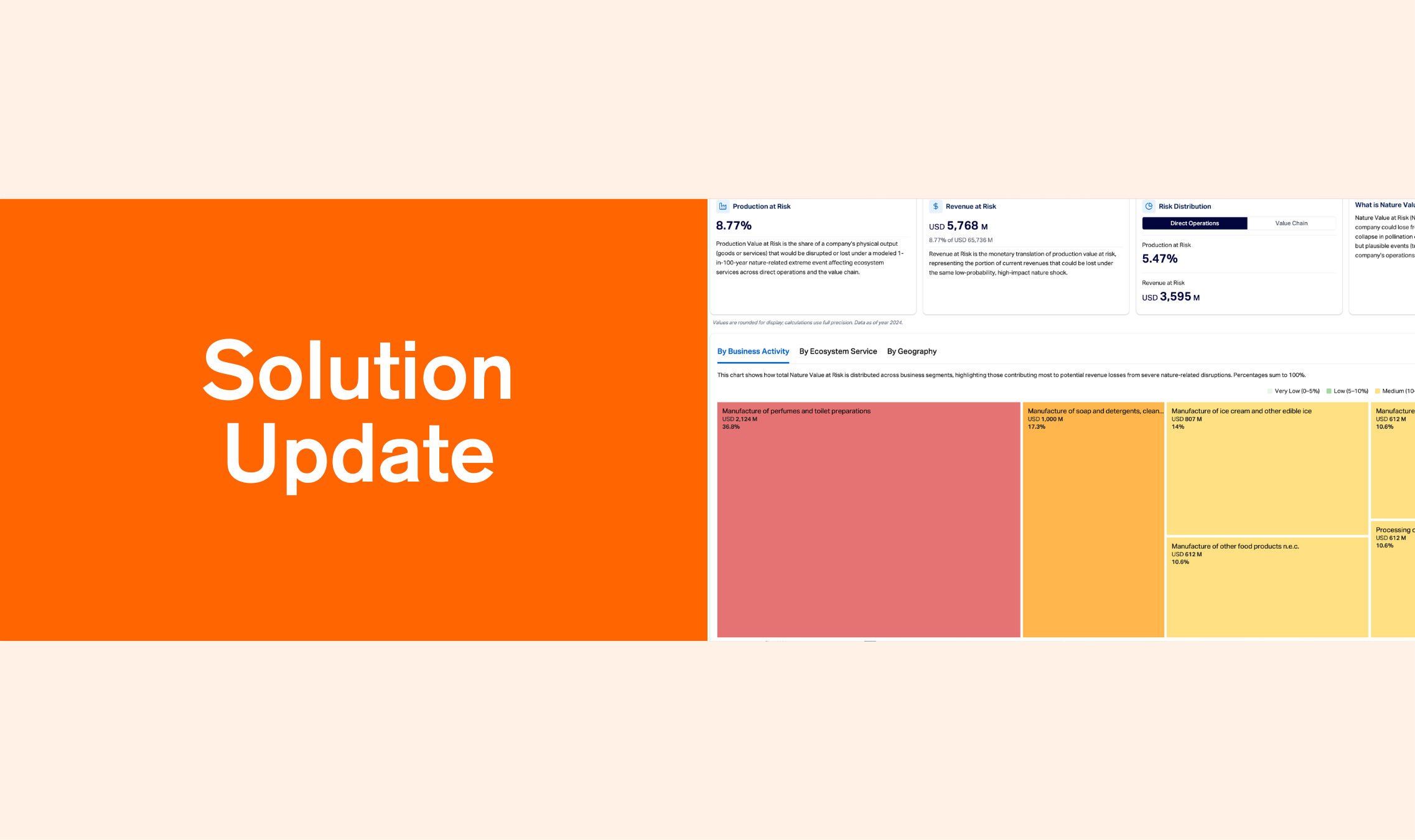
For businesses and financial institutions, this creates a growing category of exposure: nature-related risk. Nature Value at Risk (NVaR), developed by GIST Impact, helps quantify this risk by estimating how much of a company’s economic output could be disrupted by severe ecosystem degradation.
From ecosystem dependencies to financial risk
Understanding how nature affects business performance requires linking two perspectives.
The first is dependencies on ecosystem services – how companies rely on nature’s functions such as water provisioning, climate regulation, soil formation, and waste assimilation.
The second is ecosystem condition – how healthy or degraded those systems are where companies operate and source.
Where strong dependencies intersect with stressed ecosystems, nature-related disruption risk emerges.
Nature Value at Risk translates these relationships into a quantitative financial signal, helping organisations identify where ecosystem degradation could threaten production, supply chains, or revenue.

An overview of Nature Value at Risk
Nature Value at Risk (NVaR) measures the share of a company’s production that could be impaired under severe nature-related disruption scenarios. In addition, NVaR can show how much revenue is potentially exposed to severe ecosystem disruption. Further financial metrics are also possible, and are being developed right now.
Rather than focusing solely on environmental impacts, NVaR therefore focuses on economic exposure – identifying how ecosystem degradation could translate into operational or supply-chain disruption.
The result is a clear, comparable metric that helps organisations understand:
- where nature-related risks are concentrated;
- which ecosystem services drive those risks;
- and how material they could be in economic terms.
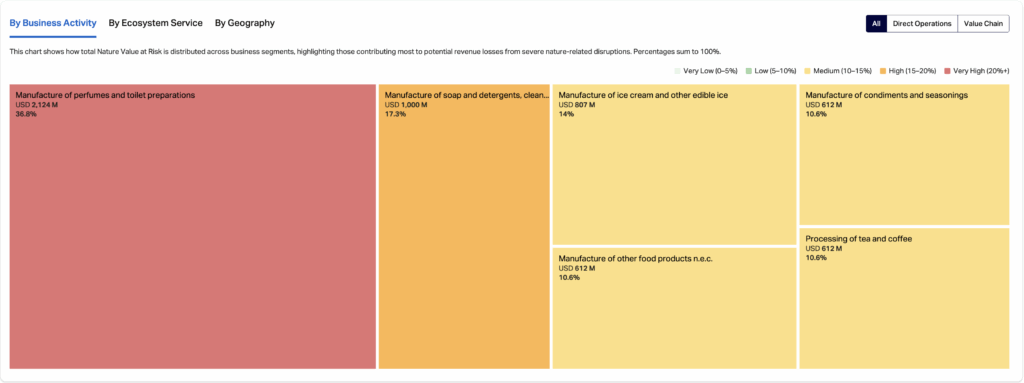
For example, a food manufacturer may face high exposure to water stress, soil degradation, and rainfall variability, while a consumer goods company may be more exposed to disruptions affecting agricultural commodities or natural inputs in its supply chain.
How NVaR works
The NVaR framework follows a straightforward risk structure:
NVaR = Potential Loss × Exposure
Potential loss represents how severely ecosystem disruption could affect a given sector in a specific geography, while exposure reflects how much of a company’s activity takes place there.
Potential loss is calculated by combining three key factors:
Hazard
The level of stress or degradation affecting an ecosystem service in a particular location.
Vulnerability
How dependent a sector is on that ecosystem service, and how resilient the local context is to disruption.
Maximum loss calibration
A sector-specific scaling factor that ensures potential losses remain aligned with real-world production variability.
Together, these elements estimate how much production could be disrupted if ecosystem services were severely degraded.
Understanding where nature risk sits
Nature-related disruption can affect companies through both direct operations and supply chains.
Some risks arise when ecosystem degradation directly impacts a company’s own facilities – for example, water shortages affecting manufacturing sites or flood risk disrupting infrastructure. Others occur indirectly through upstream value chains, when environmental stress affects agricultural production, natural inputs, or key supplier regions.
Nature Value at Risk distinguishes between these channels, helping organisations understand whether exposure is concentrated in their own operations or transmitted through sourcing networks.
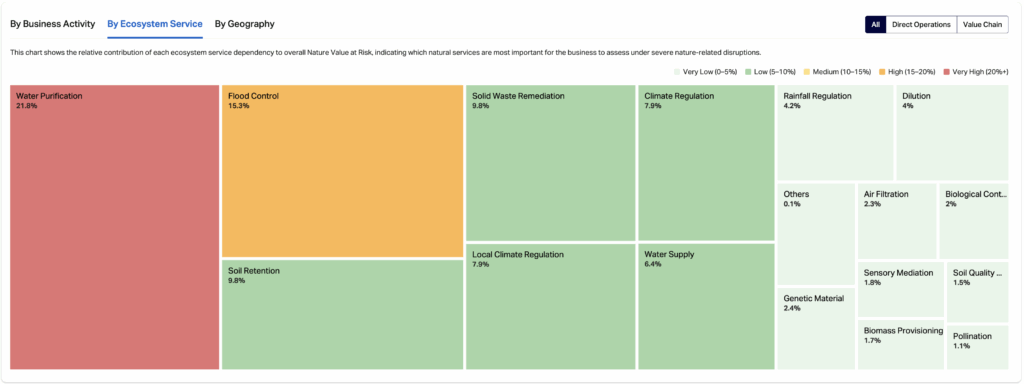
The platform also enables users to explore how this exposure is distributed across several dimensions:
Business activities, highlighting which sectors or product lines contribute most to potential disruption
Ecosystem services, identifying the natural systems – such as water supply, flood regulation, or soil retention – that drive risk
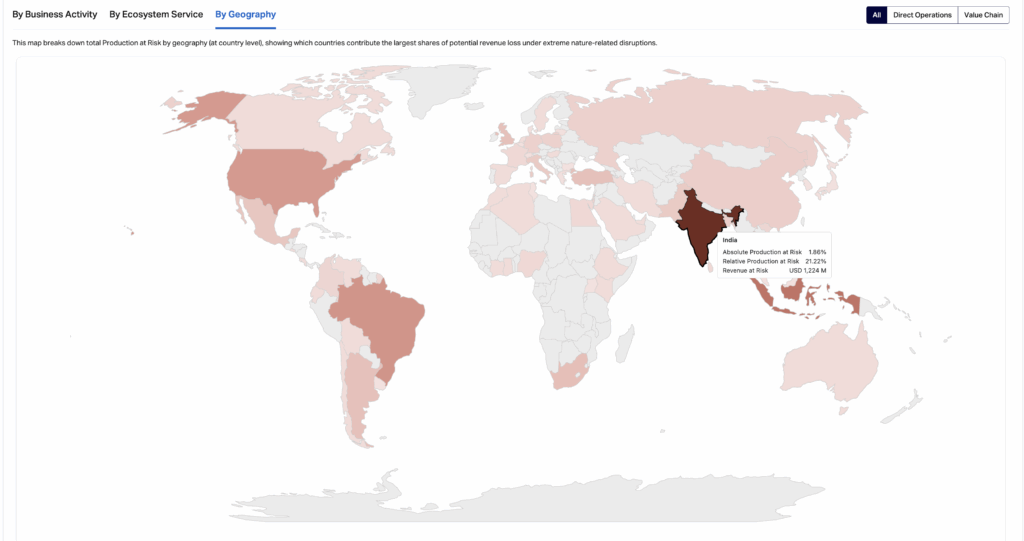
Geographies, revealing regional hotspots where ecosystem degradation intersects with major production or sourcing activities
Together, these perspectives help organisations move from a high-level understanding of nature risk to a clearer view of where exposure is concentrated and what is driving it.
From nature risk to financial insight
The core NVaR metric represents the share of production that could be disrupted under severe ecosystem degradation scenarios. This production-loss fraction can be translated into financial terms – such as revenue at risk – allowing nature exposure to be analysed alongside other financial risk indicators.
By linking ecosystem condition, sector dependencies, and economic exposure, NVaR helps organisations identify where nature-related disruption could have the greatest material impact.
These insights support a range of decisions – from screening companies and portfolios for nature exposure, to prioritising engagement with high-risk supply chains, informing materiality assessments, and monitoring how risks evolve over time.
As nature-related frameworks such as TNFD continue to mature, tools like NVaR provide an important bridge between environmental data and financial decision-making – helping organisations move from awareness of nature risk toward clear, actionable priorities for resilience and risk management.
—
If you’re excited to learn more about how this solution can support your work on nature and biodiversity, get in touch with out team to chat further and see it in action.