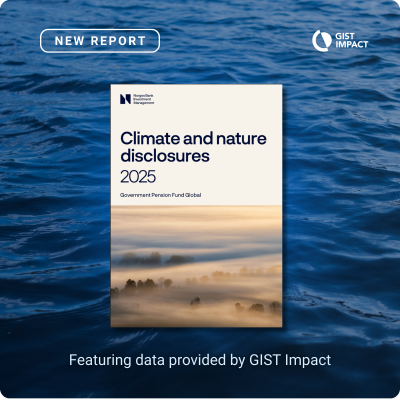


Norges Bank Investment Management (NBIM) is once again setting the standard for climate, nature, and biodiversity reporting – demonstrating how the world’s largest sovereign wealth fund is measuring and managing its environmental risks with rigour and transparency.
For the second consecutive year, NBIM has drawn on GIST Impact’s data in its annual Climate and Nature Disclosures report, using it to deepen their understanding of how their portfolio interacts with the natural world.
Using GIST Impact’s data, NBIM has provided key insights into how their portfolio interacts with critical environmental factors, including:
- Mapping biodiversity risk – Identifying how portfolio companies intersect with Key Biodiversity Areas, which are sites that contribute significantly to the global persistence of biodiversity. The analysis finds that 8% of portfolio companies’ physical assets are located near these ecologically sensitive areas.
- Quantifying natural capital impact – Measuring the economic costs of the portfolio’s business impacts on nature, calculated at $11,500 per million dollars of revenue – providing investors with a concrete, financially-grounded view of environmental risk.
- Breaking down impact intensity – Assessing the portfolio’s effect on natural capital across key drivers and sectors, giving investors deeper visibility into where nature risk is most concentrated.
NBIM’s 2025 report also marks an important evolution in how the fund approaches these issues. Their newly published 2030 Climate Action Plan formally integrates nature alongside climate, reflecting the scientific consensus that these risks are deeply interconnected and must be managed together.
For years, scientists have emphasised that climate and nature are two sides of the same coin. Now, the world’s most sophisticated investors have the data-driven tools to measure, value, and actively manage their climate, nature, and biodiversity impacts, risks, and opportunities – and NBIM’s continued use of GIST Impact’s data is a testament to that shift.
Read the full report here, and for insights driven by GIST Impact data, see pp. 28–32.