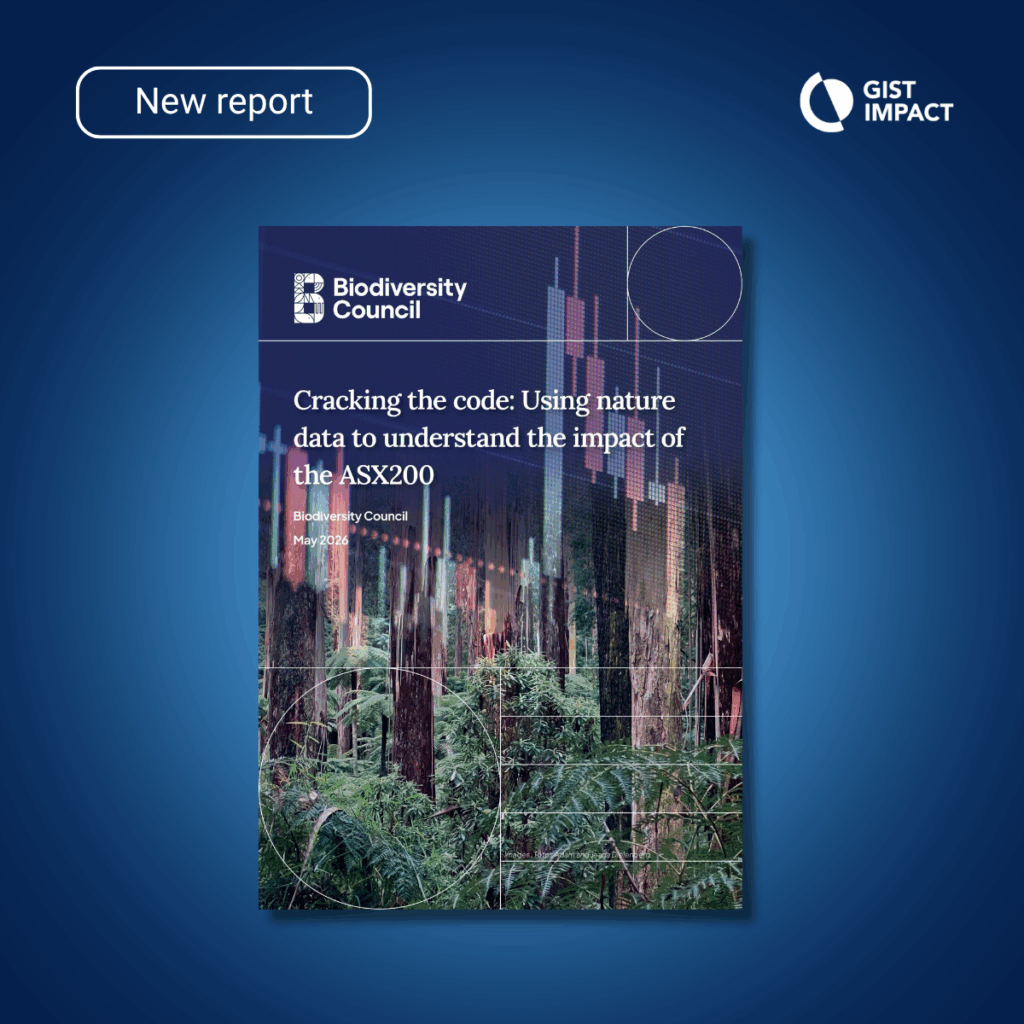


The Biodiversity Council of Australia has published a landmark report assessing the nature-related impacts and dependencies of Australia’s 200 largest listed companies – and we’re proud that GIST Impact’s global database of nature impacts and risks played a role in making it possible.
The report, Cracking the Code: Using Nature Data to Understand the Impact of the ASX200, draws on data from GIST Impact alongside MSCI and S&P to provide a comparative view of nature-related impacts across sectors and companies. The findings are significant and in some cases, surprising.
One of the most important insights is the role of distant and chronic impacts. It’s not just about what happens at the fence line. GHG emissions dispersed globally and water use downstream both have measurable effects on species diversity – impacts that traditional, proximity-based assessments routinely miss. When upstream and downstream impacts are factored in, the picture changes considerably, and sectors that appear low-impact on direct operations alone – financials and IT, for example – emerge as significant drivers of nature loss through their value chains and capital allocation.
This is precisely why asset-level, supply chain-inclusive data matters. Nature risk doesn’t stop at a company’s direct footprint, and neither should the analysis.
We’re delighted to have contributed to a piece of work that moves the conversation in Australia from awareness to action and that demonstrates what’s possible when robust data meets rigorous research.