


Over half of global GDP is estimated to be moderately or highly dependent on nature. As ecosystems degrade, that dependency turns into real business risk. These show up as disrupted supply chains, water and energy insecurity, stranded assets, tightening regulation. The Taskforce on Nature-related Financial Disclosures (TNFD) exists to help organisations get ahead of that risk.
Modelled on the well-established climate framework TCFD, it gives companies and financial institutions a structured way to identify, assess and report their nature-related dependencies, impacts, risks and opportunities. It uses the LEAP approach (Locate, Evaluate, Assess, Prepare), which underpins our own report.
Adoption is still voluntary and still early. But the more organisations that take it on, the more useful it becomes – comparable, decision-useful nature data helps investors price risk properly, helps regulators calibrate policy, and helps organisations spot exposure before it becomes a crisis rather than after.
Why are organisations adopting TNFD?
Every day, GIST Impact’s data is being used by organisations in their reporting and disclosure work. Financial institutions use it to assess portfolio risk. Corporates use it to understand their supply chains. Many of these organisations use it specifically for TNFD reporting.
So this year, we turned that lens on ourselves.
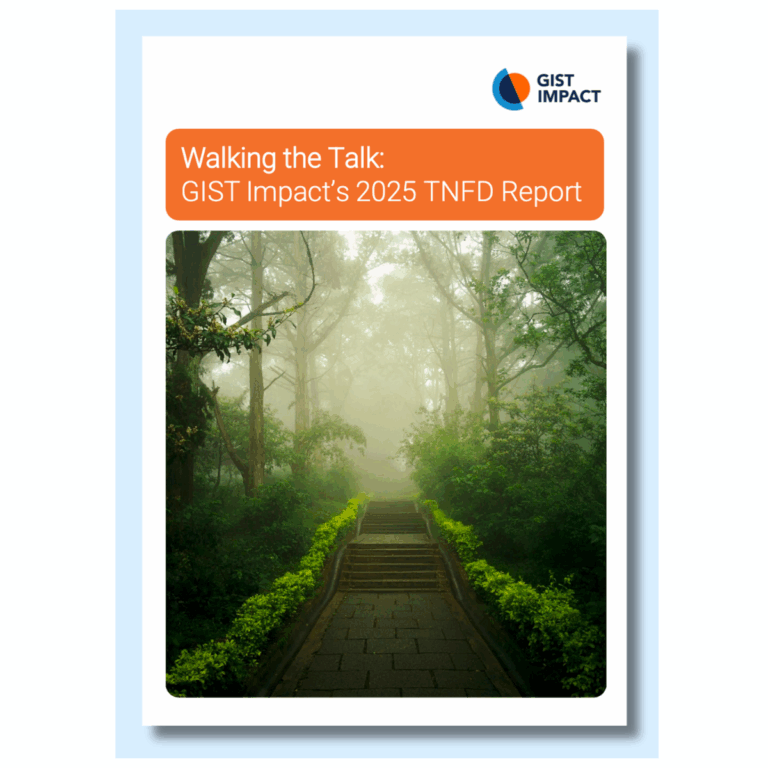
We’re publishing our first TNFD-aligned nature report – Walking the Talk, because that’s exactly what it is.
Why TNFD matters to us
TNFD adoption is voluntary, no organisation is under any obligation to do this. That’s precisely why so few organisations have started, and why the ones that do often feel like they’re stepping into the unknown without a well-used map.
We wanted this report to double as a demonstration that the process is achievable – not a flawless, resource-intensive exercise reserved for companies with dedicated sustainability teams and years of data history, but something any organisation with the will to start can achieve. Our report isn’t ‘complete’, and we say so, explicitly. It covers our direct operations and two selected upstream activities (business travel and cloud/data-centre services), not our full value chain. Our targets are interim, pending Board approval. Our Scope 3 inventory is a work in progress. But that’s the point – you don’t need a perfect baseline to publish a credible first disclosure, you just need an honest first step.
An invitation, not a benchmark
We don’t expect every organisation to reach our exact conclusions, use our exact methods, or reduce emissions to our own targets. We do hope though that this report shows that starting is possible, that first disclosures don’t need to be exhaustive to be valuable, and that data only does its job when it comes with the context to understand it.
If you’re weighing whether to begin your own nature-related disclosure journey, we’d welcome the conversation.
—
If you’d like to explore how we can support your TNFD journey, chat to our team.