


For most organisations that are starting their sustainability journeys, open-source sustainability data presents itself as a natural first step. This is rightfully so; over the past few years, open-source data has moved mountains to democratise both nature and climate intelligence by providing scientifically backed datasets equipped with the correct information that companies require.
However, there is a huge difference between having access to data, and knowing how to use it, alongside the ability to act on it with confidence. Open data opens the door, but it doesn’t always get you to a number you’d be fully comfortable defending in front of a management committee, or citing in a disclosure that regulators may scrutinise.
This is where we come in. In this piece, we lay out exactly how we build on open-source data, collaborate within the data ecosystem, and deliver decision-grade intelligence that most teams don’t have the time or the toolkit to build on their own.
What data sources do we use?
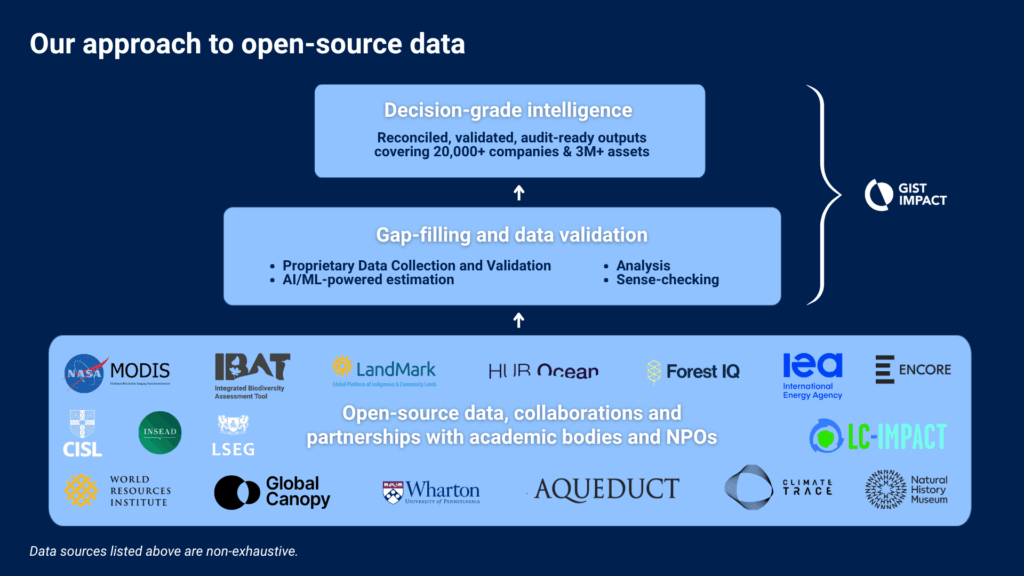
We draw on a mix of sources including proprietary data we’ve crawled or estimated in-house, open source data, academic research, and datasets stewarded by non-profit organisations. That mix includes data from:
- World Resources Institute (WRI)
- International Energy Agency (IEA)
- European Commission, Climate TRACE
- Integrated Biodiversity Assessment Tool (IBAT)
- LC-IMPACT
- Aqueduct water risk platform
- ENCORE (Exploring Natural Capital Opportunities, Risks and Exposure)
- NASA’s Moderate Resolution Imaging Spectroradiometer (MODIS)
- Global Canopy’s Forest IQ
- Natural History Museum,
- HUB Ocean
- LandMark: The Global Platform of Indigenous and Community Lands
This is a non-exhaustive list.
Transparency and traceability are part of the core values here at GIST Impact. We’re upfront about whether a given data point is licensed commercially, proprietary to us, estimated, or open source. That way, when you’re using one of our metrics, you know exactly what’s underneath it.
This matters because whatever the conversation is about, be it risk management, disclosure, stewardship, or engagement, being able to say where a number came from and what methodology produced it goes a long way. Transparency is what keeps a metric defensible when faced with pushback.
Could you just go straight to the source yourself? You could. But you’d also need to reconcile different datasets, stress-test different methodologies, check for and fill gaps, and build the audit-ready data trail. This is where we shine.
Why active ecosystem participation matters
We’re not just pulling data from open source providers and repackaging it. We’re partners and collaborators with many of them, and active participants in the standard-setting conversations that shape where this data is headed next.
This shows up in a few different ways. We have a strong presence at various Conference of the Parties (COPs), in the rooms where governmental and regulatory movements are being shaped. That proximity keeps us ahead of where standards and disclosure requirements are heading next.
Our active role in the data ecosystem also shows up in how we build our own methodology too. A recent example of this is our Natural Value at Risk (NVaR) proposition, which has been developed in close alignment with research coming out of the London School of Economics (LSE), so it reflects the most current and rigorous thinking available. We have strong roots in academia- our founding methodology traces back to the UN-backed TEEB report (The Economics of Ecosystems and Biodiversity), led by our CEO, Pavan Sukhdev, which means the science underpinning our work has always been peer-reviewed and academically thorough from day one.
We go past data processing and layer our own analysis on top of it, turning raw inputs into insights that are ready to act on.
Why does this matter to you? Standards and metrics are moving targets right now. A provider embedded in these conversations stays ahead as things change, positioned to anticipate shifts rather than simply react to them. This advantage really sets us apart.
Open data also leaves gaps, often more than teams expect, and we fill them. That’s where our proprietary data, AI/ML expertise and in-house research come in, extending coverage beyond what open source data currently offers.
Transforming raw data into decision-grade intelligence
A great way to understand how we build on this data is to think of building blocks.
The foundational layer consists of open source data that’s publicly available, academic research, and datasets from non-profit organisations. The second layer combines proprietary data we’ve crawled or estimated in-house and gap-filling. The top-most layer is the output: reconciled, sense-checked, decision-grade intelligence that’s ready to use.
Powering these layers is our AI-centric operating model that handles data crawling, estimation, validation, and analysis at a scale that would be near impossible to replicate manually. We’re currently covering more than 20,000 companies and 3 million assets, and we have flexible data delivery formats built for easy integration into the systems financial institutions already run on. Crucially, organisations don’t have to rebuild their stacks to work with us.
To see how we turn theory into action, take a look at a selection of our partnership integrations in more detail, including HubOcean, Natural History Museum (NHM), Global Canopy, ForestIQ, LandMark, IBAT, and Wharton.
Explore our full list of partner integrations and collaborations here.
Could you do this yourself?
Yes, much of this data is open and publicly accessible. We acknowledge that, build on it deliberately, and actively help produce these metrics and standards.
But converting raw datasets into actionable insights requires reconciling fragmented sources, stress-testing methodologies, filling data gaps, and navigating ever-evolving disclosures. All of these demand specialised academic, industry and domain expertise, not to mention significant time and team bandwidth.
What we provide is the infrastructure and team of experts that puts that data to work via proprietary data and modeling, meticulous validation, and AI/ML-driven engines that turn raw inputs into decision-grade intelligence. The data is out there, but we make it usable, comparable, and defensible at scale.
Our stance is simple – we don’t compete with open-source data, we complete it.
—
Ready to start using our data? Get in touch with our team.