



We’re coming to the collective realisation that not all AI can be trusted. In fact, you can only trust it as far as you trust the data behind it, and the motives of those managing it.
AI sustainability data has become popular for good reason: AI has gotten remarkably good at pulling a number out of a dense report. Ask a chatbot to find a company’s emissions figure buried in a miniature table on page 40 of its annual report, and it hands you an answer in seconds. But, that capability is table stakes now.
We’ve noticed that the real challenge now lies in AI explainability – knowing why the AI landed on that number, whether it’s right, and in turn, whether you feel comfortable enough to defend it in front of an auditor, an investor, or your own internal committees. For financial institutions, that challenge is very material, as disclosure and portfolio decisions carry real legal and financial weight. Our own research backs this up, too. The value of AI comes down to the data it’s built on. Tools that lean on surface-level, self-reported disclosures alone can miss exaggerated claims and the information companies would rather leave out.
At GIST Impact, we do things differently. We build trust in our AI sustainability data through explainability. Our AI explains itself at the point of data creation, well before it reaches our clients. Here’s how that works.
What do we mean by ‘AI explainability’?
‘AI explainability’ is an industry-wide term. It refers to where organisations try to build transparency for humans to show how the AI model is working, thinking, and coming to a final answer. We recognise the importance of AI explainability, and have prioritised transparency in this area. To illustrate:
Before a single document gets read for a specific data point, our AI is already working upstream. It gathers data from multiple sources, cleans it, and fills gaps that feed the models downstream. Explainability starts at intake, before extraction even begins. When a metric appears across multiple reports, our AI applies metric-specific priority logic. For example, this means that it selects the Annual Report for financial metrics like Revenue, and the Sustainability Report for metrics like Scope 1 emissions. This targeted approach guarantees every data point comes from its most authoritative source.
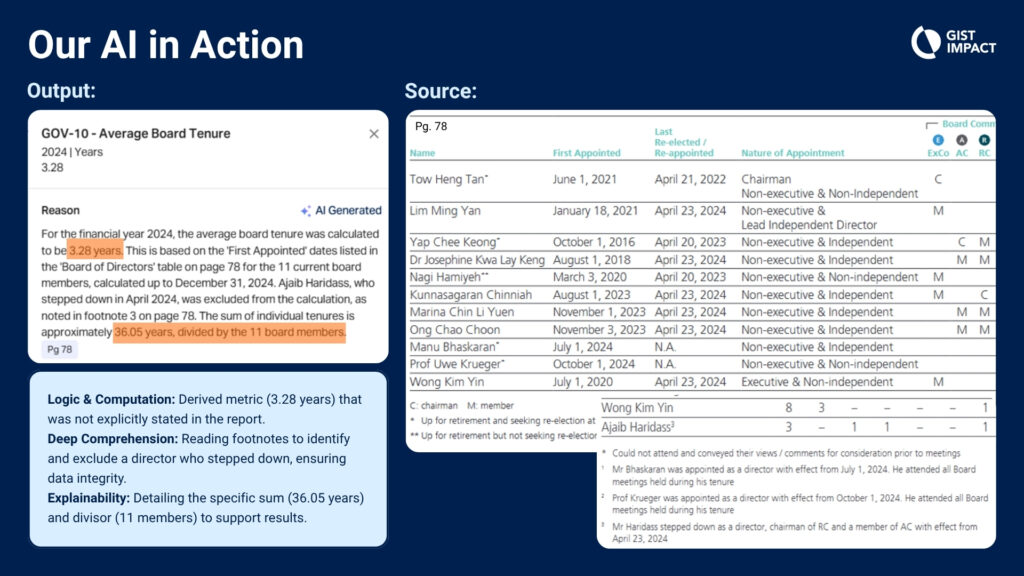
Our proprietary platform, Sustain Data, powers this process by continuously crawling and collecting public corporate disclosures. By deploying AI to extract both quantitative metrics and qualitative insights from these sources, it builds the reliable data foundation behind everything we deliver. For quantitative data, the AI cites the exact source page. The AI shows its working when a figure is calculated instead of outrightly stated. Take ‘average board tenure’: a company rarely reports this number directly. So, our AI compiles the list of board members, calculates the average, 3.28 years for example. It even records that logic in a reasoning field anyone can check.
How do we handle qualitative data?
Qualitative data follows the same principle. Companies often describe a transition plan or a CapEx commitment across several pages rather than as one tidy figure. Our AI reads across those pages and writes out its reasoning. The distinction that matters here is that explainability comes from the point of data creation. You get the full reasoning trail behind every metric, giving you the confidence you need in how defensible the data is.
Where traceability and transparency fit in
Our core principles for data reliability are traceability and transparency. Every AI-derived data point traces back to a specific source page, along with the scientifically robust methodology behind any calculation involved.
That traceability lives in Sustain Data, independent of how it reaches our end user, whether through an API, Snowflake, or a workbook. And this traceability drives true data transparency. Within Sustain Data, every metric links directly to its original source or a scientifically robust methodology document, giving you complete visibility into how each figure is derived. The trust is built into the data itself, so it carries through to whatever format we deliver to our clients.
Reliability also depends on the model staying sharp over time. Our AI evolves continuously through human feedback and expertise, from data labelling and training to exception handling and real-world refinement, keeping outputs credible as regulations and expectations shift.
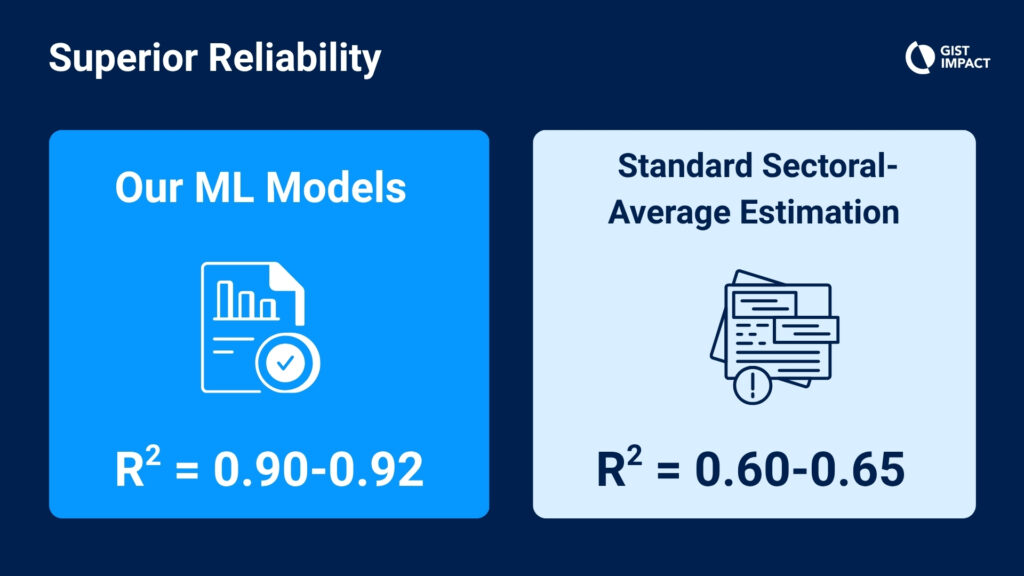
That reliability shows up in the numbers too. For instance, on Scope 1 and 2 emissions estimation, our ML models achieve an R² of 0.90–0.92 against actual reported figures, compared to 0.60–0.65 for standard sectoral-average estimation. The gap comes down to training: our models learn from validated, granular company data rather than broad sector benchmarks, so the estimates track much closer to what companies actually report.
Whether you encounter a number in a dashboard, our platforms or a data workbook, the reasoning behind it is always available. That’s what makes this data reliable, and ready to sit inside whatever environment your team uses today, and wherever that expands to next.
—
Get in touch with our team to see how our AI sustainability data seamlessly integrates into your workstreams.