
Daiichi Life Group has published its Sustainability Report 2026, and we’re proud that GIST Impact’s Nature Value at Risk (NVaR) solution features in its nature-related risk analysis.

Getting to know Daiichi Life Group
Founded in 1902 as Japan’s first mutual life insurance company, Daiichi Life Group is now a global insurance and asset management group. It serves around 76 million customers, and operates across Japan, Australia, North America, New Zealand, India and South-East Asia.
The Group is also one of Japan’s largest institutional investors. Its two main life insurers, Daiichi Life and Daiichi Life Frontier, manage roughly ¥44 trillion (USD 277 billion) in investments between them.
Sustainability is built into that investment activity. Consequently, the Group has committed to a cumulative ¥5 trillion of sustainability thematic investments by March 2030. It had reached ¥3.7 trillion by the end of the 2025 fiscal year, including ¥1.9 trillion in climate and environmental solutions.
How Daiichi Life used Nature Value at Risk
Nature Value at Risk estimates the share of a company’s production that could be disrupted under severe nature-related scenarios. In simple terms, it combines three things:
- The condition of ecosystem services where a company operates,
- How heavily its sector depends on them, and
- How much of its activity is exposed.
The result is a single, comparable financial signal. Daiichi Life ran a pilot assessment using our NVaR data. The analysis covered domestic listed equities, domestic corporate bonds and domestic loans across Daiichi Life and Daiichi Life Frontier. Bringing loans into scope this year widens the Group’s view of its exposure.
The data can be broken down by sector and by ecosystem service, so the Group could see not just how much risk exists, but where it sits.
What the analysis found
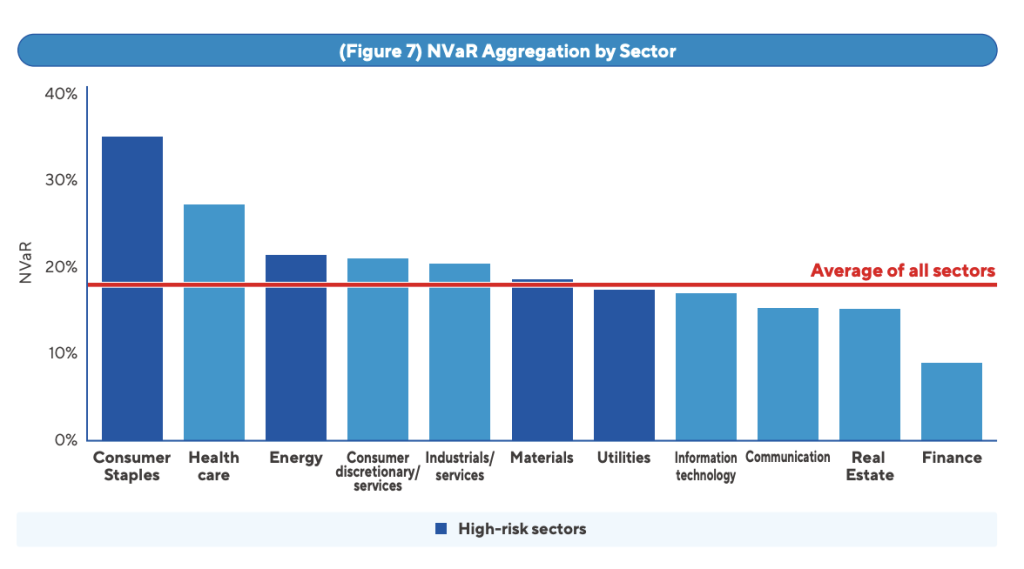
- Broad exposure: The average NVaR across all sectors was around 18%. In almost every sector, most investment sat in companies with medium or higher NVaR, which points to wide-ranging nature-related exposure across the portfolio.
- Sector hotspots: NVaR was particularly elevated in Consumer Staples and Energy, two of the sectors the Group already treats as high risk. Healthcare also showed significant exposure.
- Water stands out: Water-related ecosystem services drove especially high risk in Consumer Staples and Healthcare, while air-related services were relatively high in Energy and Utilities.
- Activity-level insight: Additionally, the analysis also reviewed representative high-risk activities, such as crude oil extraction in Energy and steel manufacturing in Materials.
Why quantifying nature risk matters
Nature underpins economic activity, yet few financial institutions can say how much of their portfolio is exposed to its decline. Turning ecosystem dependencies into a financial metric helps investors prioritise engagement, screen holdings and focus resilience efforts where they matter most.
Daiichi Life is open that methods for assessing nature-related risk are still developing and that no internationally established standard exists. As a result, the Group describes this as an ongoing effort and plans to keep refining its approach. We share that view, and we’re glad to support the work.
Climate change and biodiversity collapse are the two issues we are running out of time to address. Institutions like Daiichi Life, which measure nature-related risk and then act on what they find, are showing what leadership looks like. We’re proud that our data supports that work.
—
Ready explore how NVaR could support your nature and climate analysis? Chat to our team.