
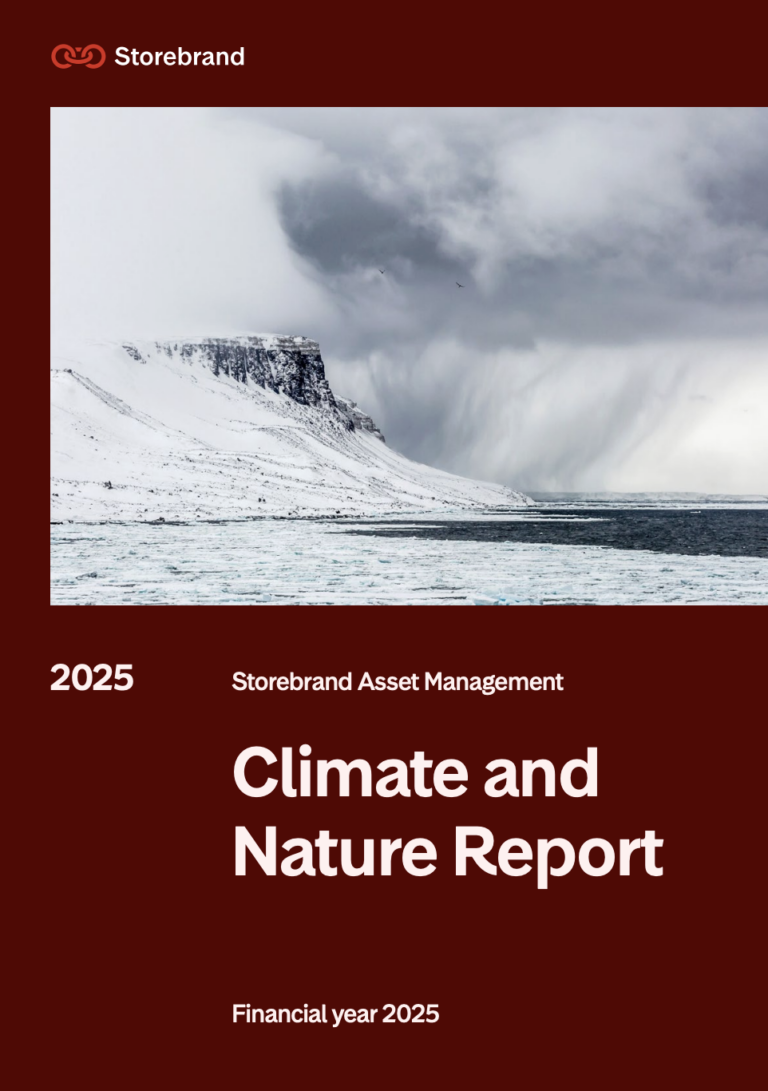
Storebrand Asset Management has published its latest Climate and Nature Report, and we’re proud that GIST Impact’s data sits at the heart of its nature analysis.
The Storebrand Climate and Nature Report 2025 brings climate and nature disclosures into a single framework, and draws on our asset-level data and modelling to show how a large investment portfolio both depends on nature and affects it.
Get to know Storebrand Asset Management
Storebrand Asset Management (Storebrand AM) is one of the largest private asset managers in the Nordic region. It has NOK 1,609 billion (roughly USD 170 billion) invested in companies around the world, and 95% of that is managed for institutional clients such as pension funds, insurers and municipalities.
Sustainability has been central to Storebrand since it set up a dedicated team in 1995. It is a founding signatory of the UN-supported Principles for Responsible Investment, a founding member of the Net Zero Asset Owner Alliance and Nature Action 100, and an early adopter of the Taskforce on Nature-related Financial Disclosures (TNFD).
Building on last year’s collaboration
This is the second time we have provided the underlying data for an external Storebrand AM report. In October 2025, we published Integrating Nature Data Into Investment Decisions with Storebrand Asset Management. That report analysed the 100 largest Nordic companies and found that their impact on nature was 42% lower than a global benchmark, although pressure on nature was still rising.
This latest report signals Storebrand AM’s ongoing commitment to advancing how nature and climate data is integrated into investment decisions. The scope is also much wider in scope this time around. Instead of a portfolio of 100 Nordic companies, the latest analysis covers Storebrand AM’s listed equity and corporate bond portfolio, compared against the MSCI ACWI benchmark. It examines more than 1.8 million company assets, with asset data covering around 91% of the portfolio by market value.
How our data shaped the report
Storebrand AM’s first combined Climate and Nature Report in 2024 identified a critical gap: it lacked portfolio-wide data on where companies’ assets are located.
In the latest report, Storebrand AM says our science-based datasets are “setting a new standard for how investors can assess biodiversity and natural capital”. It adds that this has allowed a far more comprehensive disclosure of nature-related impacts and dependencies, built on our modelling frameworks and, crucially, companies’ asset locations.
We carried out an integrated TNFD LEAP assessment (Locate, Evaluate, Assess, Prepare) across the portfolio. Our data underpinned:
- Sensitive locations: asset-level geospatial analysis of proximity to Key Biodiversity Areas, protected areas, threatened-species ranges, Indigenous Peoples’ and local communities’ lands, and Marine Protected Areas.
- Priority-sector exposure: company activities mapped to TNFD’s high-priority sectors using granular, activity-level classifications.
- Biodiversity footprint: potential species loss linked to the portfolio, expressed as Land Conversion Equivalence in square metres.
- Ecosystem service dependency: each company’s reliance on 25 ecosystem services, scored company by company rather than from sector averages.
- Water risk: exposure to water stress at the level of individual river basins and locations.
Key findings
The analysis found that Storebrand AM’s portfolio compares well with its benchmark on nature, though some hotspots stand out:
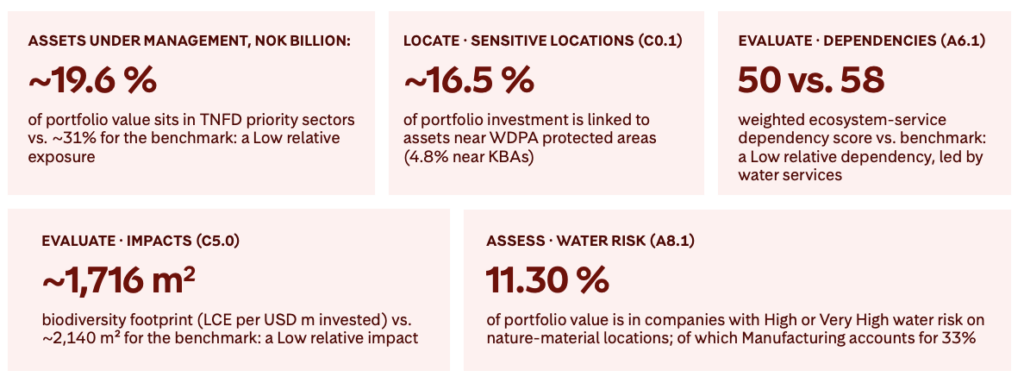
- Lower sector exposure: about 19.6% of portfolio value sits in TNFD priority sectors, against around 31.6% for the benchmark.
- Lower biodiversity impact: the footprint is around 20% below the benchmark, and has been below it in every year since 2021 when the 2025 portfolio is held constant.
- Lower dependency: a weighted ecosystem service dependency score of 50, compared with 58 for the benchmark.
- Manufacturing as a hotspot: the sector drives around 55% of the biodiversity footprint.
- Water as the unifying risk: 11.30% of portfolio value is in companies with high or very high water risk at nature-material locations.
A first on ocean sensitive areas
The report also breaks new ground on the ocean. It offers a large-scale, cross-sector look at how a listed equity portfolio is exposed to ocean sensitive areas – a first for financial institutions.
The analysis found that 5.99% of portfolio investment is linked to assets within 1 km of a Marine Protected Area. Finance and Insurance and Manufacturing account for most of that exposure, largely because of their weight in the portfolio.
Seeing exposure at this level helps investors understand where ocean-related risk sits. Dive deeper into GIST Impact’s ocean data, delivered in partnership with HubOcean, to find out more.
Why asset-level nature data matters
Nature risk is hyper-local. A factory in a water-stressed basin carries a very different risk from an identical one elsewhere, and a sector label alone cannot tell the two apart. Materiality matters too. The report’s nature materiality assessment keeps only assets whose activities put high pressure on nature, so factories and mines are separated from low-impact offices and branches. Around 16% of the 1.85 million assets assessed were considered nature-material. Knowing where assets are, and what surrounds them, turns broad nature concerns into specific insights that investors can act on in engagement, stewardship and portfolio construction.
That is the principle behind our asset data and nature and biodiversity solutions. We work with asset managers and other financial institutions to make nature data decision-useful and aligned with frameworks such as the TNFD.
We congratulate Storebrand AM on a rigorous and transparent report, and we’re proud to support its work on climate and nature.
—
Ready explore our data could support your own nature and climate analysis? Chat to our team.