



If you work in the sustainability space in any capacity, you’ve probably heard some version of this. “Nature data is too complicated, let’s revisit it down the line.”
This is large in part because nature data is a lot more nascent and complex compared to climate data. For starters, there’s no single metric you can default to, like CO2e. In the nature data space, new metrics get introduced, refined, or replaced within a couple of years. A biodiversity indicator you adopted eighteen months ago for screening might already be considered “outdated.” For teams used to stable climate data, rapid change can feel like a lack of standardisation. The natural instinct is to wait for the field to mature until a ‘just right’ metric emerges.
While that’s understandable, it’s also short-sighted. Nature risk impacts markets regardless of whether your organisation has acted on it yet. Dr Thomas Moran, our Head of Nature and Biodiversity Products, put it well when speaking to Environmental Finance: “this is an exciting time for materiality, with plenty of low-hanging fruit still to be picked even as more rigorous analysis continues to develop alongside it.”
‘Imperfect’ nature data you can use today beats ‘perfect’ nature data that doesn’t exist yet, every single time. Let’s unpack why.
Why is nature data more complicated than climate data?
While both climate and nature risks are location-specific, the primary goal for climate has always remained straightforward. It is to curb emissions to limit global warming. Standard GHG emissions accounting has allowed organisations to measure, aggregate, and map assets, companies, and portfolio’s climate impact relatively easily regardless of sector and geography.
A question a lot of investment and risk teams ask is “why isn’t there a single ‘nature score’ the way there’s a GHG footprint?” The simple answer is that nature has no such equivalent. As our Chief Growth Officer, Mahima Sukhdev, recently pointed out, nature data is inherently complex and simply cannot be reduced to a single metric.
Its impacts are both hyper-local and multi-dimensional. Variables as distinct as species populations, soil health, water availability, and ecosystem functionality rely on different units and are measured independently. This makes it close to impossible to squeeze nature risk into one tidy number.
For financial institutions (FIs), the practical implication is that nature risk screening needs several complementary metrics working together across a portfolio. And there’s no single universal benchmark doing all the work.
That shift in expectation is already visible in how the industry now talks about nature data. As Dr Thomas Moran has observed, a couple of years ago the emphasis was on breadth, how many assets a database covered. But the conversation has since moved to materiality: whether the data actually covers the points that matter most for a given portfolio. Anupam Ravi, our Chief Commercial Officer, has gone further, noting that financial materiality has become the central topic in almost every conversation with FIs.

What nature and biodiversity metrics are organisations using today?
Today’s nature and biodiversity toolkit is more mature than it gets credit for. However, it spreads the data across a handful of purpose-built metrics rather than bundling them into one.
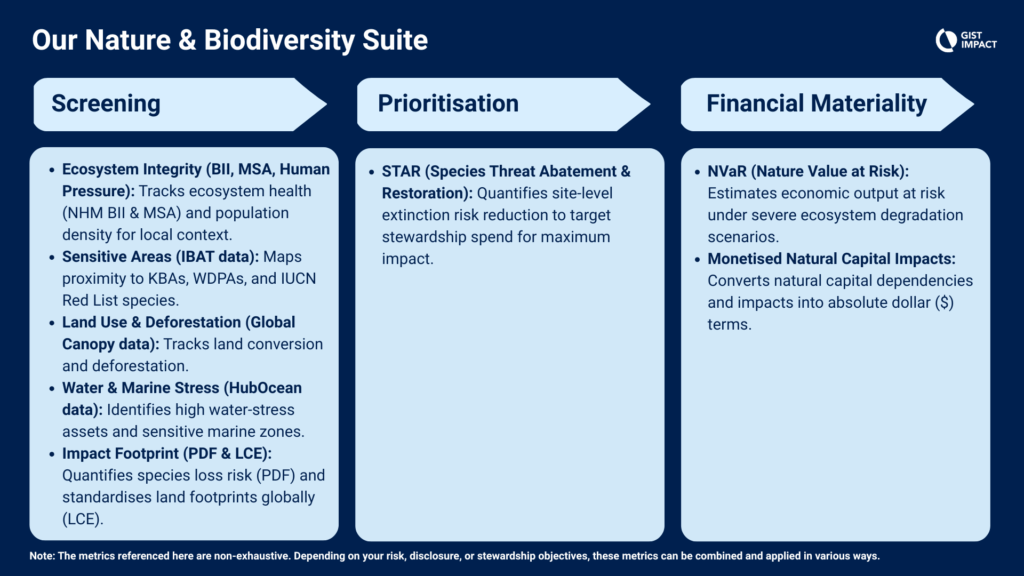
Combining ecosystem intactness metrics (Mean Species Abundance (MSA), Biodiversity Intactness Index (BII)) with footprinting data (Potentially Disappeared Fraction (PDF), Land Conversion Equivalence (LCE), and land use change data) shows FIs where portfolio exposure sits. For example, which holdings sit near degraded ecosystems, shrinking forest cover, or protected areas. That directional read supports benchmarking exposure across regions, sectors and assets, science-based target setting, stronger engagement and disclosure, and reporting under frameworks like TNFD.
From there, a prioritisation metric like Species Threat Abatement and Restoration (STAR) points to where stewardship spend and engagement will actually move the needle, rather than spreading effort evenly across every holding.
Financial-translation metrics like Nature Value at Risk (NVaR) and natural capital impacts, take it a step further. They convert that picture into numbers a credit or investment committee can act on. For example, standardising land-use impact so a holding’s footprint in one geography can be weighed against others in a completely different ecosystem. The same follows for estimating how much economic output could be impaired under severe-but-plausible nature degradation scenarios across operations and supply chains.
Put together, that’s a full chain: location, to ecosystem condition, to financial exposure. We follow this logic for our own Nature & Biodiversity suite, summarised below. Our suite pairs sensitive-location screening and ecosystem integrity data with financial-translation outputs. This enables you to get a full picture of portfolio and asset-level exposure.
Why acting today beats waiting
Regulatory timelines don’t wait for anyone. TNFD, CSRD and SFDR are all moving ahead regardless of the maturity of nature data. Every year of delay is a year without anything to measure future progress against and guide decision-making.
For an FI, today’s baseline, imperfect as it may be, anchors next year’s more refined metrics. Wait, and you risk starting next year even further behind and directionless than you are now. Stewardship and engagement conversations with investees can begin now on science-based directional evidence. Consequently, better precision arriving later refines that engagement history rather than erasing it.
It’s worth noting that data availability isn’t really the bottleneck anymore. As Storebrand Asset Management‘s Head of Climate and Nature, Emine Isciel, has argued, “businesses don’t need perfect information to act on nature risk, the harder part now is interpreting and applying what already exists.”
The evolution of nature data reflects a maturing field in action. Treat today’s toolkit – MSA and BII for ecosystem condition, STAR for prioritising action, land use change for deforestation exposure, and NVaR for translating all of it into financial terms, as the starting line rather than the finish line. Portfolios built on that foundation now will have a track record while others are still waiting for the “perfect” metrics that might never arrive.
—
Ready to start using nature data? Get in touch with our team.