


Financial institutions are under growing pressure to assess and report on nature-related risks, impacts, and dependencies, while consultancies face rising demand to help clients navigate that work. Compared to the relatively mature landscape of climate data, nature data remains a nascent space, one that is still evolving to establish its baseline metrics. It’s complex, multi-layered, and often hard to translate into actionable insight. The TNFD’s LEAP framework offers a structured pathway through this complexity, but it works best when paired with the right underlying data.
Reconomy, operating across the UK, EU and North America, is a circular economy leader and sustainability consultancy that lives this challenge from both sides, assessing its own operations while also advising clients as consultants.
Their 2025 Sustainability Report shows what’s possible when the right data is applied across the LEAP approach, and it’s a useful case study for those navigating the same terrain.
Why TNFD’s LEAP?
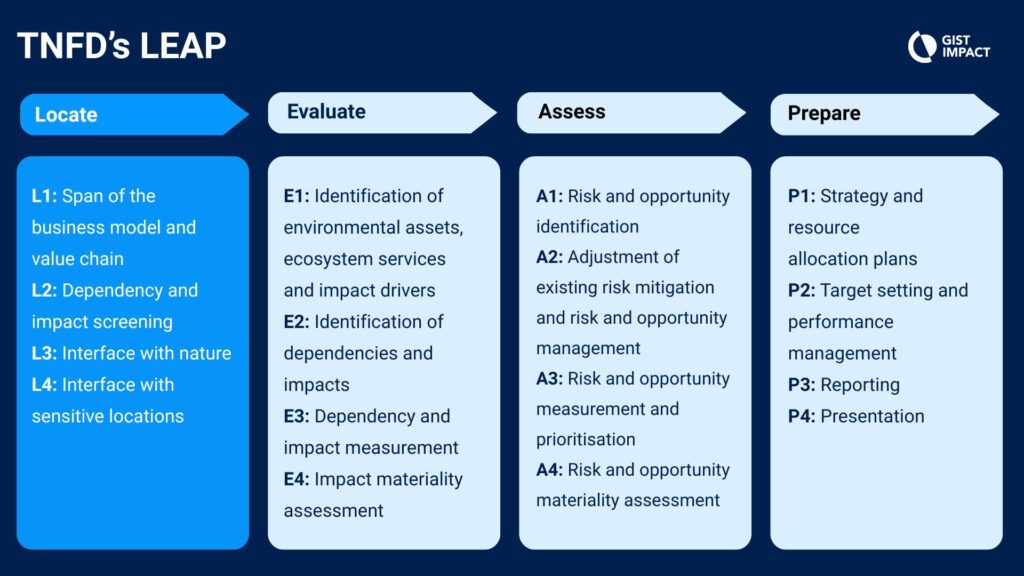
The Taskforce on Nature-related Financial Disclosures’ (TNFD’s) LEAP is the framework it introduced to guide organisations through nature-related reporting via Locate, Evaluate, Assess, and Prepare stages.
Adoption is voluntary and but increasingly expected, with growing links to regulatory frameworks like the EU’s CSRD and the ISSB standards. CSRD’s ESRS E4 requires companies to report impacts and dependencies within each asset’s localised area of influence, across the full value chain, and SFDR’s regulation of investors and lenders creates downstream pressure on the companies they fund to produce the same asset-level data.
As a result, LEAP has become the go-to approach for nature-related reporting. Financial institutions, like Allianz, have used LEAP to evaluate their portfolio, while consultancies use it as a definitive blueprint for guiding clients through complex disclosures.
Central to the strength of any LEAP analysis is the quality of the nature data behind it. Let’s get into it, using Reconomy’s recent experience.
Locate: Where does a business interface with nature?
The first step in LEAP is identifying which assets, business locations, and supply chains interface with sensitive locations.
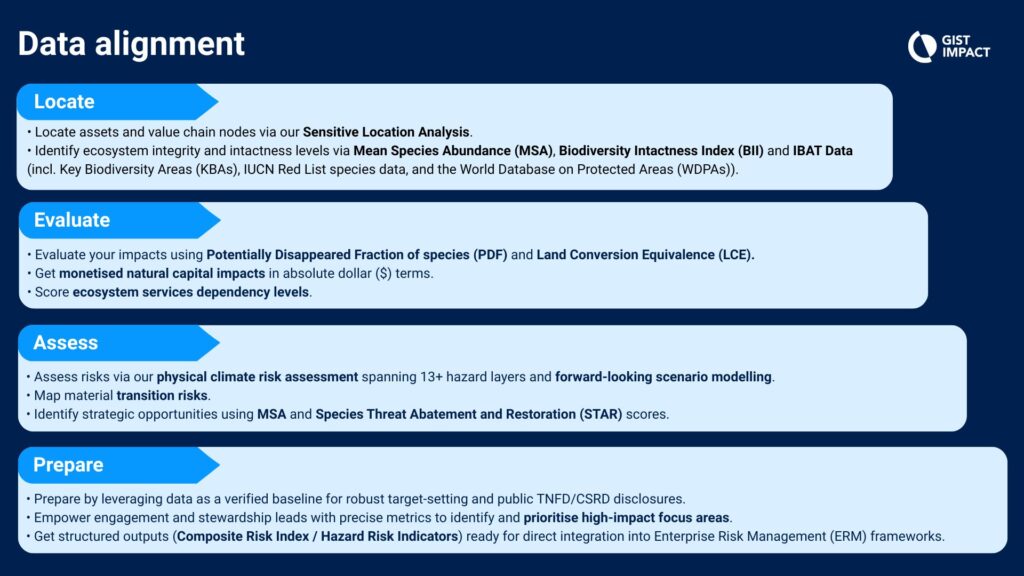
For Reconomy, this meant mapping assets and supply chain nodes across their direct operations and value chain against Mean Species Abundance (MSA), a metric that signals ecosystem integrity by measuring how closely the current state of an ecosystem’s biodiversity matches its original, undisturbed reference state.
Direct operations sit predominantly in transformed urban environments. A significant and reportable positive result was that there were no direct operations within sensitive areas.
Certain supplier sites were identified as presenting opportunities to protect areas with high MSA scores, or restore areas with low MSA scores.
Supply chain locations in India, Chile, China, Mexico, and North America were flagged for elevated physical climate and water-related exposure.
We also provide a sensitive location analysis using data from the Integrated Biodiversity Assessment Tool (IBAT) and the Biodiversity Intactness Index (BII) in collaboration with the Natural History Museum for financial institutions (FIs). This includes portfolio-ready and validated outputs, suitable for FI screening and client-level reporting.
For FIs, a clean Locate output feeds directly into credit risk assessments, investment screening, and M&A due diligence, since a red flag in sensitive location analysis can materially impact any of these processes.
For consultancies, this output forms the foundation for any credible TNFD disclosure they help a client build. It gives them a defensible starting point to bring into early client conversations, grounded in verified location data.
Evaluate: What Are the Dependencies and Impacts?
The Evaluate phase looks at which ecosystem services a business depends on, and what impacts its operations and value chain have on nature in return.
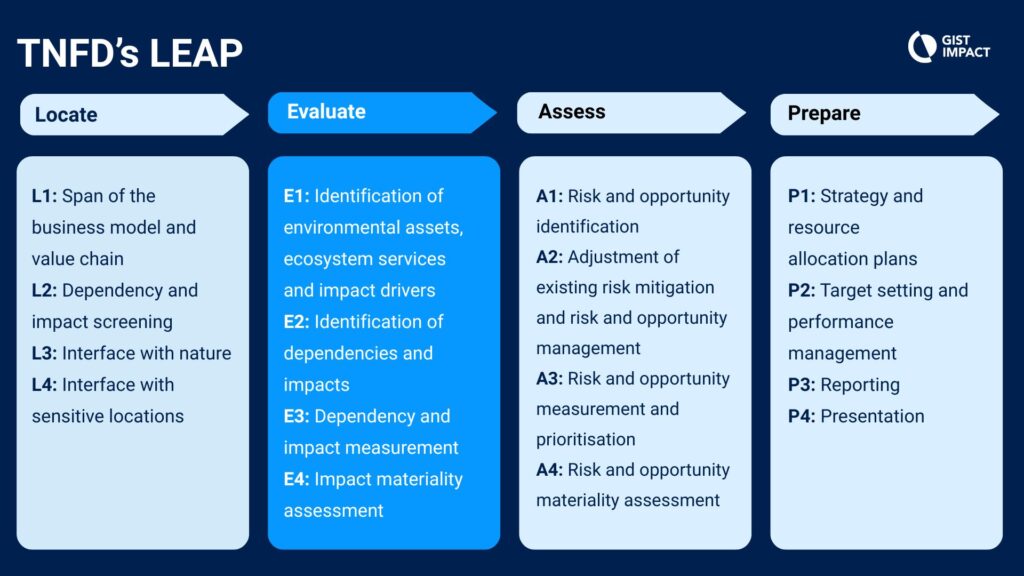
This involved scoring dependency levels, from negligible to very high. Furthermore, the scoring was across key services like water regulation, air quality, flood control, and pollination. It also involved natural capital impact metrics and a biodiversity footprint analysis, assessed beyond Scope 1 assets.
The result? Overall ecosystem service dependencies were predominantly low. But granular analysis highlighted a medium dependency within Reconomy’s Recycle Loop division across five ecosystem services. The analysis provided a clear focus for materiality work going forward.
We assessed Reconomy’s impacts using two metrics: Potentially Disappeared Fraction of species (PDF), a metric that captures the risk posed to global species stocks in a given year as a result of an entity’s activities across terrestrial, freshwater, and marine realms; and Land Conversion Equivalence (LCE), a metric that translates the potential loss of global species into the equivalent area of natural land that would need to be urbanised to cause the same level of biodiversity impact.
Moreover, applying these metrics surfaced useful findings for Reconomy:
- External facility impacts identified potential odour and dust risks for waste facilities located near communities. Consequently, this further informed their community engagement strategy.
- Supply chain footprint analysis confirmed GHG emissions as the primary impact driver, rather than land use or water consumption. The finding provided an important distinction for target-setting.
For FIs, dependency scoring identifies where nature risk is material and where it isn’t, and PDF/LCE quantify biodiversity impact. These are essential for TNFD and SFDR Article 9 Principle Adverse Impact (PAI) reporting. Together, these give asset managers precise transition-risk mapping alongside data-driven engagement strategies.
For consultancies, dependency scoring builds the evidence base for prioritisation and client workshops. Translating ecological risk into intuitive metrics, like LCE, gives them decision-useful data to build a tangible business case for nature.
Assess: What Are the Nature-Related Risks and Opportunities?
The Assess phase identifies material nature-related risks (looking at physical, transition, and systemic risks), alongside opportunities, and integrating these findings into business and financial planning.
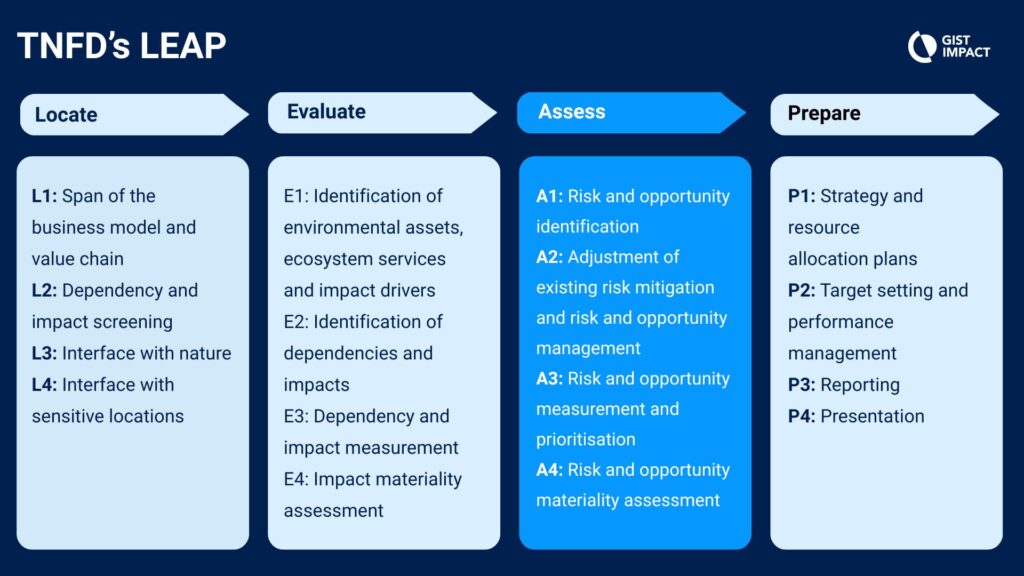
This meant physical climate risk and scenario modelling across a baseline and three forward-looking assessments for 2030 and 2050, under both 2°C and 4°C warming scenarios. The Composite Risk Index (CRI) and Hazard Risk Indicators (HRI) aggregated nine physical risk layers, with supply chain risk mapping extending to asset-level exposure and upstream vulnerability, designed for integration into Enterprise Risk Management (ERM) frameworks.
Moreover, a dominant theme that emerged across both assets and supply chain was water-related hazards. Geographic hotspots driven by extreme water scarcity, drought, and rising temperatures were identified. Some UK-based suppliers were flagged separately for flood risk exposure. The 2050 scenario modelling showed a progressive intensification of water stress and extreme heat, giving Reconomy a long-term lens for investment and procurement decisions.
These findings fed directly into Reconomy’s ERM process through cross-functional workshops with finance directors, sustainability leads, and operational heads. The risk data continues to support Reconomy’s progress toward its Near Term and Net Zero science-based carbon targets, delivered through its Environmental Action Plan.
For FIs, scenario-modelled physical risk at asset and supply chain level is exactly what’s needed for climate-related financial disclosure and long-term portfolio stress testing.
For consultancies, this data provides a foundation for guiding clients through TNFD alignment while supporting broader business planning. Additionally, having a complete risk overview allows consultancies to demonstrate where nature risk isn’t material, an insight that carries just as much weight as identifying where it is.
Prepare: How Does Data Translate Into Strategy and Reporting?
The final phase of LEAP is where organisations formulate their response, set nature-related targets, and ‘prepare’ their public disclosure.
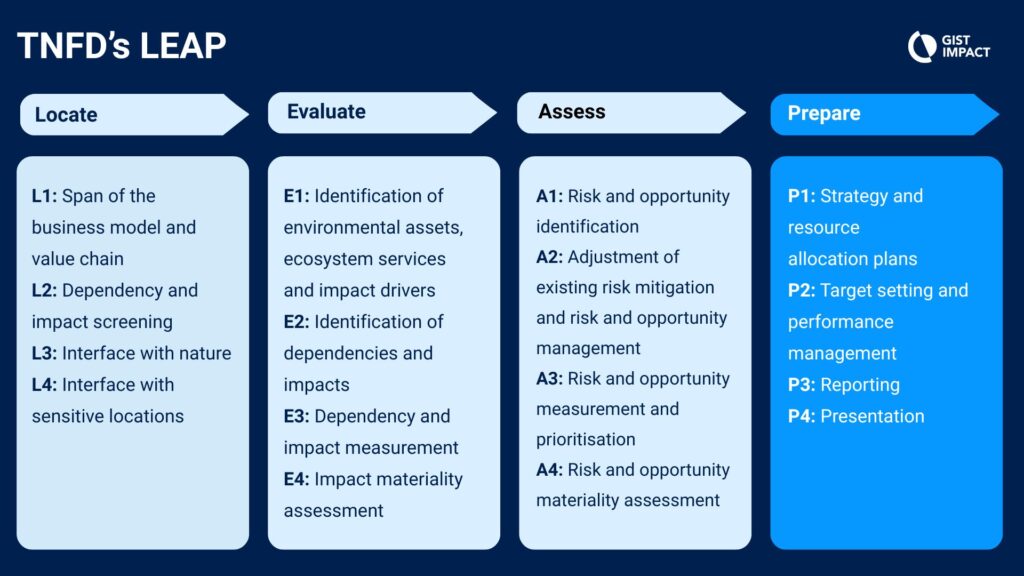
Typically, the insights generated across Locate, Evaluate, and Assess do the heavy lifting, serving as the vital catalyst for this final step. For Reconomy, earlier phases gave the organisation a verified baseline, one that supported confident target-setting and a defensible, TNFD-aligned disclosure in its annual sustainability report.
When it comes to FIs, the Prepare phase carries relevance for engagement and stewardship leads, who can use it to identify and prioritise areas which will have the most impact.
And for consultancies, this verified baseline gives clients the structural support they need to confidently commit to targets and publish disclosures, turning the Prepare phase into a natural next step rather than a final hurdle.
What changed for Reconomy?
By the end of the process, Reconomy had more than a disclosure – it had a working risk map. Water scarcity and flood exposure were flagged early enough to shape ERM planning, not just report on it. A single division’s dependency on five ecosystem services, invisible at the aggregate level, became a clear focus for future materiality work. And a verified baseline across Locate, Evaluate, and Assess meant the final Prepare phase was a formality, not a scramble. On the reporting side, Reconomy also draws on our partner Novisto‘s platform to help manage and structure its disclosure workflow.
That’s really the difference between doing LEAP and using it. Nature disclosure is a competitive differentiator for consultancies, and a risk management imperative for financial institutions – but only when the underlying data is good enough to survive scrutiny at every stage, not just the final report.
—
Ready to take the LEAP? Get in touch with our team.