Feeling the heat? What rising temperatures mean for business

Share:

Table of Contents

Recent Posts
A pocket guide to climate and nature risk

Between record-shattering heatwaves and increasingly frequent extreme weather, the physical impacts of climate change have become impossible to ignore. Physical climate risks are actively manifesting inside balance sheets, and extreme heat is fast becoming a financially significant risk investors and businesses face today.  

According to a new UN WMO report, global temperatures are projected to surpass the 1.5°C warming threshold within the next five years, with 2027 on track to set new heat records. Given we are already halfway into 2026, seeing this laid out so clearly is a harsh reality check on many fronts, but how does it affect businesses?

Why is extreme heat financially material?

Extreme heat is becoming increasingly prevalent globally, and the financial consequences are starting to show up.

Europe’s largest insurer, Allianz, has comprehensive models, estimating that by 2030, extreme heat could wipe out up to 7% of GDP in major European economies, shrinking both investment values and returns on capital. Financial institutions are already bracing for the hit to their bottom line, recognising it as a structural economic risk.

So the question is not whether rising temperatures will have an impact; it is how big that impact will be, where it will hit hardest, and how soon. 

What does this mean for businesses?

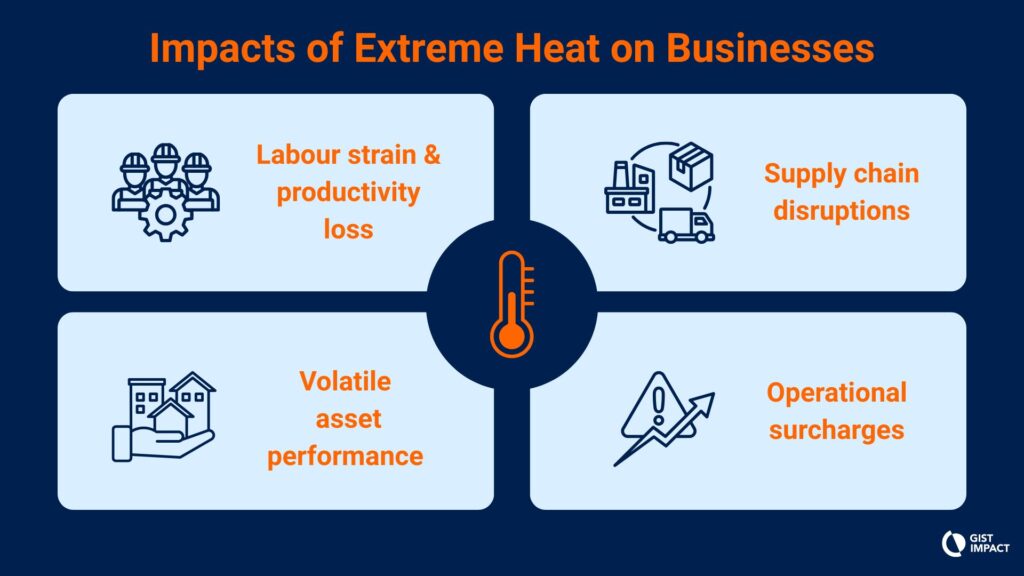
In practical terms, extreme heat does not affect all businesses in the same way. But its reach is broader than what once might initially assume. Here are some of the ways in which extreme heat can impact organisations:

Labour strain and productivity loss

Extreme temperatures can compromise workforce safety and output, particularly in labour-intensive industries and hotter climates. This can trigger operational slowdowns, reduced productivity, and direct revenue losses, all of which compound quickly in highly exposed regions. 

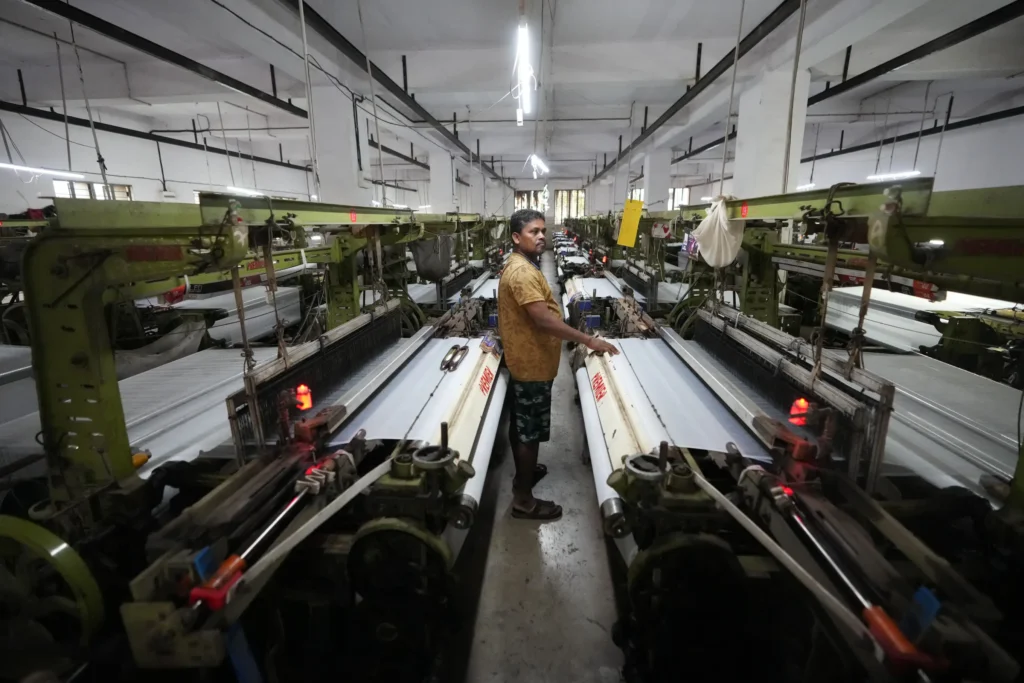
We are seeing this play out in real time, with garment factories in India supplying global retailers like Uniqlo, Marks & Spencer, and Tesco are reporting productivity losses of up to 10% as a direct result of extreme heat. 

Migrant worker Sibaram Pradhan works at a power loom factory that produces polyester cloth in Surat, India, Thursday, May 28, 2026. (AP Photo/Ajit Solanki) Source: AP News

Volatile asset performance

Physical infrastructure, technology, and equipment are prone to faster degradation under sustained heat stress. For asset-heavy businesses, this can result in higher maintenance costs, faster depreciation, and knock-on effects for investors considering long-term asset value.

Supply chain disruptions

Extreme heat can disrupt resource availability, reduce commodity yields, and create logistics bottlenecks; this can create squeezed margins across sectors, often before products even reach the market. When a historic drought crippled Taiwan’s water supply, TSMC was forced to truck in water to avoid a total shutdown, perfectly illustrating how an upstream resource crisis can trigger costly logistics bottlenecks and squeeze global margins.

Operational surcharges

To beat the heat, cooling and energy demands are prone to spike in heat-exposed regions. Combined with rising insurance premiums and increased overhead costs, the increased operational burden becomes very real, very fast.

Note: The above list is not exhaustive. The ways in which heat risk impacts a business will vary by sector, geography, and asset type.

Non-exhaustive examples of how extreme heat impacts businesses.
How to get ahead

Understanding that extreme heat is a risk is one thing. Being able to quantify it, map it to your specific assets, and more accurately plan around it is another. At GIST Impact, we help you understand:

  • Which of your assets face high exposure today, so you know where the risk sits right now.
  • How that risk evolves over time, modelled across 2030, 2050, and 2080 using IPCC scenarios.
  • How heat risk interacts with other physical risks, using composite risk scores to give you the full picture rather than a single-hazard view. We are also currently building a new feature that lets you view industry benchmarks and see how your risk stacks up against your peers. 
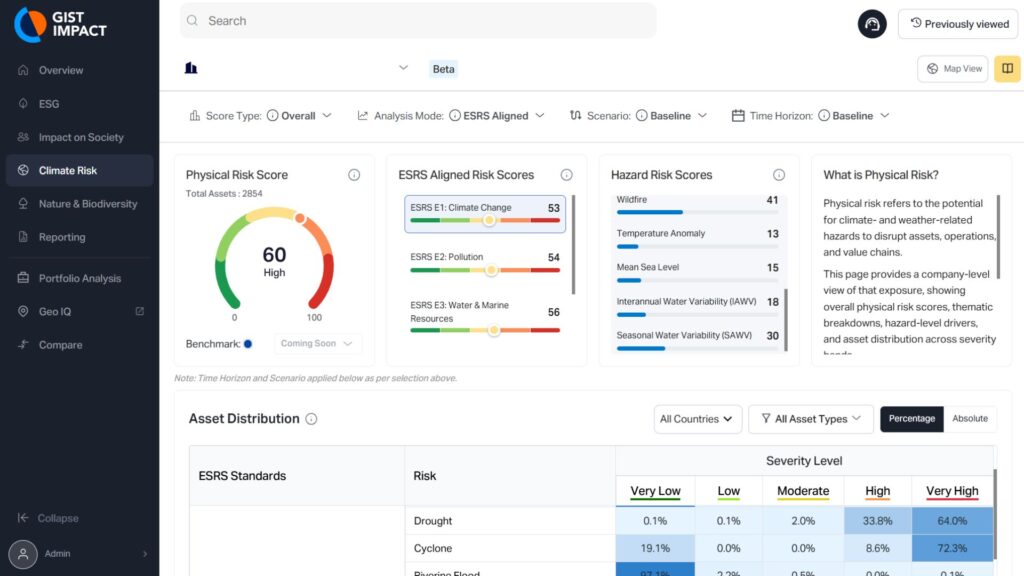
Here’s a look inside our Data Portal, featuring ESRS-aligned composite risk scores and breakdowns of 16 individual risk layers across 3 IPCC-aligned scenarios and future time horizons (2030, 2050, and 2080).
Key takeaway

Extreme heat is no longer a distant or abstract threat – it is a financially material risk reshaping balance sheets today. From productivity losses on factory floors to supply chain bottlenecks and surging operational costs, the effects are already visible across sectors and geographies. With global temperatures on track to breach the 1.5°C threshold within years, the window to get ahead of this risk is narrowing.

How many more record-breaking summers and billion-dollar losses will it take before financial institutions price this risk into every portfolio, every loan, and every investment decision?

Ready to see where climate risk sits in your portfolio? Get in touch with our team.